Page 1 of 3
Multi layered SSS skin model
Posted: Mon Sep 03, 2007 11:48 pm
by CoolColJ
don't know if this has been posted before
http://graphics.ucsd.edu/papers/layered/
There are some values we can use I think.... seeing the different SSS layers , help understand how to do this in Indigo
there are RGB absorbtion and scattering values given in the PDF for epidermis, dermis, and the bloody dermis, the "g" value for Henyey Greenstein phase function, and layer thickness, but what's the "n" value for?
edit - "n" is the IOR

so it is time to test this one day, my old lightwave female head should do the trick

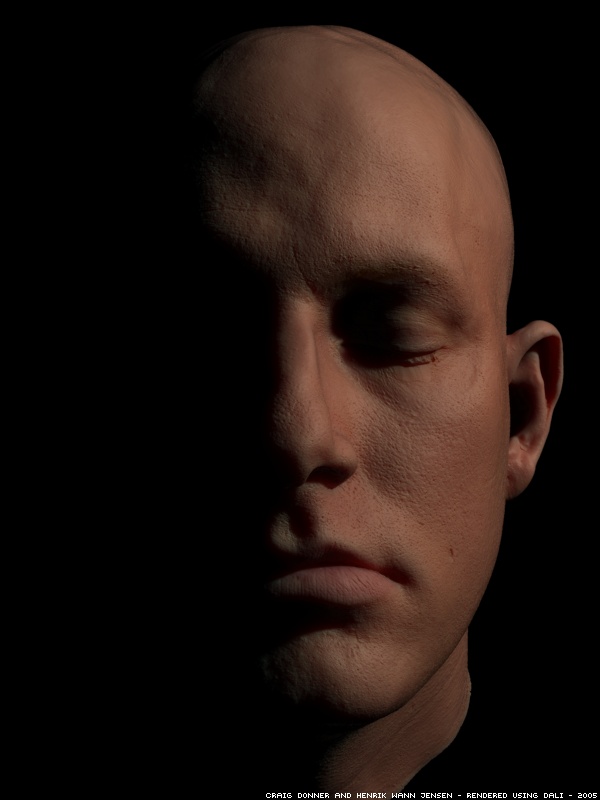
This face model was rendered using a layered skin model described in this paper. The skin is composed of three layers: epidermis, dermis, and the bloody dermis. The scattering parameters for the individual layers are from measured data available in the medical physics literature. Note that the multilayered model gives the skin a less waxy look compared to the standard BSSRDF (dipole diffusion) based skin rendering shown below
Posted: Tue Sep 04, 2007 12:15 am
by matsta
awesome! looks completely real. great find.
Posted: Tue Sep 04, 2007 12:31 am
by BbB
Yes, great. Though he looks a bit made-up to me. A little powdery, as though he'd just got out of a television studio...
Posted: Tue Sep 04, 2007 12:37 am
by Stur
Isn't the paper Ono used to build SSS Epidermis & Dermis stuff in Indigo ?
Posted: Tue Sep 04, 2007 12:42 am
by CoolColJ
crazy, there are no bump maps, or textures used at all!!!!
it's just geometry from a 3d scanned head and 3 layers of SSS!

same with the leaf in the PDF, no textures....
eventually you could probbaly reduce everything down to SSS scattering and absorbtion levels, with displacement mapping for thickness and surface detail

Posted: Tue Sep 04, 2007 12:52 am
by CoolColJ
Stur wrote:Isn't the paper Ono used to build SSS Epidermis & Dermis stuff in Indigo ?
probably not as there are no parameter values used like hemoglobin that can be found in Indigo, just basic absorbtion/scattering values etc
so technically speaking you could get the same result by creating the 3 layers with the right values. That's if Indigo renders the same way though
Posted: Tue Sep 04, 2007 1:00 am
by CoolColJ
Posted: Tue Sep 04, 2007 1:07 am
by Stur
Yep, he used another paper from the same site though. I've been misleaded by the model used in the paper.
Posted: Tue Sep 04, 2007 1:11 am
by CoolColJ
Posted: Tue Sep 04, 2007 1:30 am
by CoolColJ
the only thing is - why doesn't Indigo's Skin SSS system use virtual layers instead of having to physically model the separate layers?
That can get really expensive polycount wise with highly detailed models you find in humans and such!!!
Posted: Tue Sep 04, 2007 2:21 am
by Kram1032
'cause it's tricky to code, I bet
...and it's hard to set them up, in some cases... in example, if you render a hand... completely different skin thickness - or do you have no bones in your fingers, which are 20cm thick? xD
Posted: Tue Sep 04, 2007 2:41 am
by OnoSendai
You need to have a read of the Indigo Manual CoolColJ.
I've already implemented the dermis/epidermis stuff from that paper (or one of Jensen's other papers).
Someday I plan to implement the fast multi layer scattering approximation as well.
Posted: Tue Sep 04, 2007 2:50 am
by Kram1032
uhm....
If *I* didn't miss anything, CoolColJ meant Virtual layers to implement
We all know, that Indigo has Epi-/Dermis
AND he talked about 3layered system, where Indigo has two layers....
Basically, the request was for virtual layers, though
Posted: Tue Sep 04, 2007 2:56 am
by CoolColJ
I've already read the Indigo manual - a lot of times
but I wasn't talking about dermis/epidermis stuff though.
Virtual SSS layers so you don't have to model the actual layers, and then you can change layer depth/size at will with each having their own absorbtion/scattering, IOR values etc
maybe even have a UV map for each layer for depth/thickness.....
Posted: Tue Sep 04, 2007 2:59 am
by Kram1032
Multiple UV maps per mesh, would be cool, in general